El Elyon
|
NOTICE
This particular 2013 study has been completely rewritten and expanded, but is
currently available in PDF form only. I have left the former study online below
for anyone who is unable to download or uncomfortable downloading from the
internet. Click here to download the 2019 "El Elyon" study for free.
Go to the Table of Contents to view all teachings and downloads.
|
· · · · · · · · · ORIGINAL 2013 STUDY · · · · · · · · ·
El Elyon / El 'Elyon
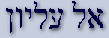
The name "Elyon" is sometimes written as "'Elyon" (with an accent mark before the "E"). For the purpose of clarity only — and not to dispute which representation is correct — I have arbitrarily chosen to use "Elyon" (without the accent mark).
Pronounced 'El-yon, the word "elyon" is an adjective and derives from the Hebrew root 'lh, meaning to "go up" or "ascend". In each case in which the adjective occurs, it denotes that which is highest or uppermost. It is used to describe....
- the height of objects:
- 2 Kings 15:35 — "However, the high [elyon] places were not taken away. The people still slaughtered and burned incense on the high [elyon] places. He built the Upper Gate of the House of
 ." (TS98) ." (TS98)
- 2 Kings 18:17 — "The king of Assyria sent Tartan and Rabsaris and Rabshakeh from Lachish to king Hezekiah with a great army to Jerusalem. They went up and came to Jerusalem. When they were come up, they came and stood by the conduit of the upper [elyon] pool, which is in the highway of the fuller's field." (WEB)
- the prominence of persons:
- Psalm 89:27 — "'I will also appoint him my firstborn, the highest [elyon] of the kings of the earth.'" (WEB)
- the prominence of Israel as a nation:
- Deuteronomy 26:19 — "...so as to set you high above [elyon] all nations which He has made, for a praise, and for a name, and for esteem, and for you to be a set-apart people to your Elohim, as He has spoken." (TS98)
- Deuteronomy 28:1 — "And it shall be, if you diligently obey the voice of your Elohim, to guard to do all His commands which I command you today, that your Elohim shall set you high above [elyon] all nations of the earth." (WEB)
When applied to Yahweh, the name "Elyon" stresses His highest supremacy. When the two names "El" and "Elyon" are combined, the resultant name can be literally translated as "the Extremely-Exalted, Sovereign, High God", as in Psalm 57:2 — "I cry out to the Most High Elohim, To El who is perfecting all matters for me." (TS98)
The Name "Elyon" Standing Alone
The single name "Elyon" appears in the Scriptures 34 times — many in poetic passages, especially in the Psalms, and it appears in Moses' final song in Deuteronomy 32:8 — "When 'Elyon gave each nation its heritage, when he divided the human race, he assigned the boundaries of peoples according to Isra'el's population." (CJB)
Further passages in the Old Testament that use the single name "Elyon":
- Numbers 24:16 (as a separate name parallel to El) — "the speech of him who hears God's words; who knows what 'Elyon knows, who sees what Shaddai [the Almighty] sees, who has fallen, yet has open eyes:" (CJB)
- 2 Samuel 22:14 — "Yahweh thundered from heaven, the Most High [Elyon] uttered His voice." (WEB)
- Psalm 7:17 — "I will give thanks to Yahweh according to His righteousness, and will sing praise to the name of Yahweh Most High [Elyon]." (WEB)
- Psalm 83:18 — "That they may know that You alone, whose name is Yahweh, are the Most High [Elyon] over all the earth." (WEB)
- Psalm 91:1 — "He who dwells in the secret place of the Most High [Elyon] will rest in the shadow of the Almighty [Shaddai]." (WEB)
- Psalm 97:9 — "For you, Yahweh, are most high [Elyon] above all the earth." (WEB)
- See also Deuteronomy 32:8; 2 Samuel 22:14; Psalm 9:2, 18:13, 21:7, 46:4, 47:2, 50:14, 73:11, 77:10, 78:17, 82:6, 87:5, 91:9, 92:1, 97:9, 107:11; Isaiah 14:13-14; Lamentations 3:35,38; Daniel 4:17, 24-25, 32, 34, 7:18, 22, 25, 27; Hosea 7:16, 11:7.
The Compound Name "El Elyon"
The compound name "El Elyon" (translated "God Most High" or "Most High God") occurs 12 times in the Old Testament. It first occurs four times in Genesis 14:18-20,22 — 18Melchizedek king of Salem brought forth bread and wine to celebrate Abram's military victory: and he was priest of God Most High [El Elyon]. 19He blessed him, and said, 'Blessed be Abram of God Most High [El Elyon], possessor of heaven and earth, 20and blessed be God Most High [El Elyon], who has delivered your enemies into your hand.' Abram gave him a tenth of all. 22Abram said to the king of Sodom, 'I have lifted up my hand to Yahweh, God Most High [El Elyon], possessor of heaven and earth.'"
Further passages in the Old Testament that use the compound name "El Elyon":
- Psalm 78:35 — "They remembered that God [Elohim] was their rock, the Most High God [El Elyon] their redeemer." (WEB)
- Psalm 78:56 — "Yet they tempted and rebelled against the Most High God [El Elyon], and didn't keep His testimonies;" (WEB)
- Daniel 3:26 — "Then Nebuchadnezzar came near to the mouth of the burning fiery furnace: he spoke and said, 'Shadrach, Meshach, and Abednego, you servants of the Most High God [El Elyon], come forth, and come here.' Then Shadrach, Meshach, and Abednego came forth out of the midst of the fire." (WEB)
- See also Psalm 9:2; Daniel 3:26, 4:2, 5:18, 21.
Back to Table of Contents
 

 
|